
A wet wipe can solve a small, immediate problem. With the right design, it can also open a digital journey, strengthen an event sponsor’s message and support a social cause. That was the opportunity behind Wipeful’s 17-day project for uhealth at Viena Naktis Nidoje 2026.
On 8 August 2026, Nida Central Beach became a large open-air dance floor for Viena Naktis Nidoje, the free annual summer event hosted by Lithuanian journalist and presenter Andrius Tapinas. Organisers later estimated that approximately 12,000 people attended. For sponsor uhealth, the event offered more than logo exposure: it was a chance to introduce a digital healthcare platform to thousands of people in a moment when convenience, personal care and mobile access naturally made sense.
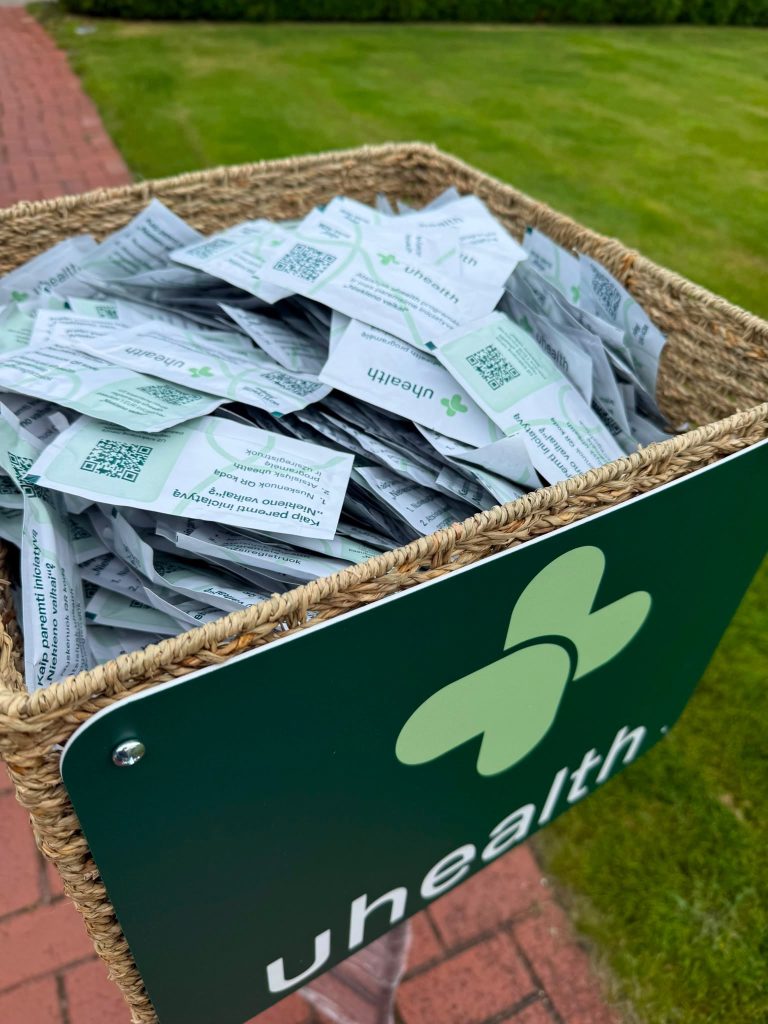
Wipeful was asked to produce individually wrapped branded wet wipes for baskets placed around the event area. Guests could use them after eating, after visiting the facilities or whenever they wanted to freshen up during the night. The wipe therefore had an obvious functional role. Its packaging, however, was designed to do much more.
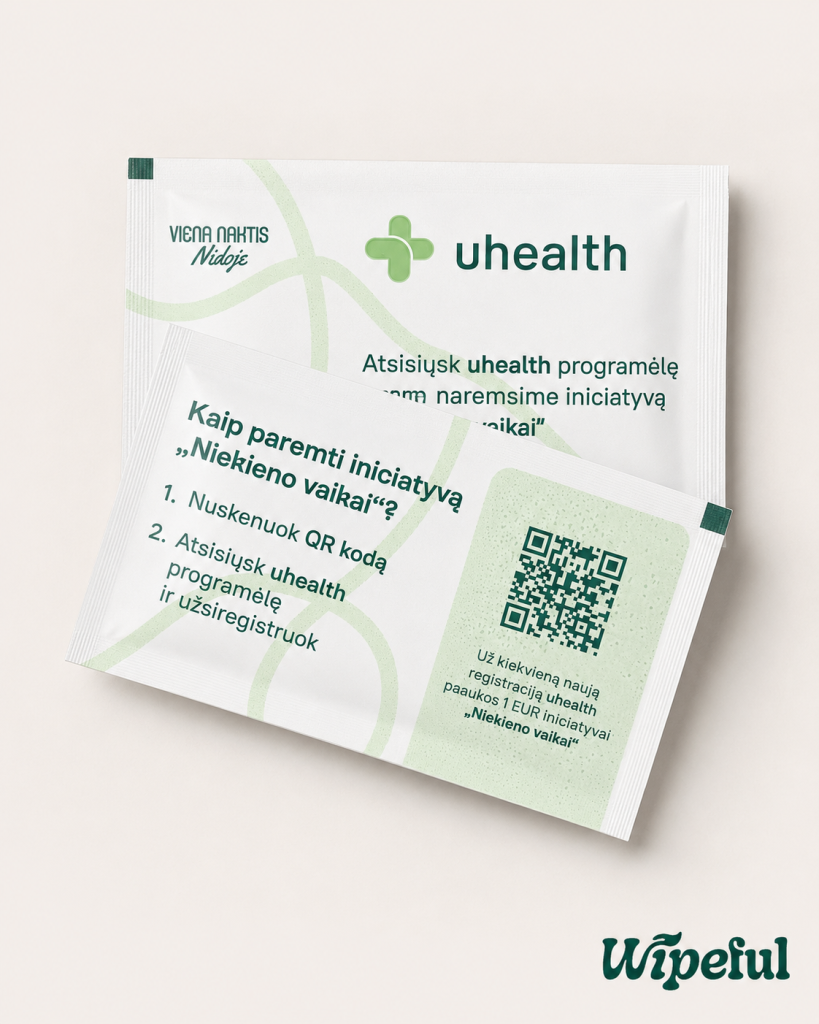
Each sachet carried uhealth branding, a clear Lithuanian call to action and a QR code leading to the app journey. The social promise made the action more meaningful: for every new full registration, uhealth pledged EUR 1 to Niekieno vaikai, an initiative supporting children who are left without a parent or legal guardian beside them in hospitals and crisis centres.
| OUTCOME The custom wet wipes arrived in time, were distributed as useful hygiene touchpoints across the event and connected an offline brand experience to a mobile registration journey with a charitable reason to act. |
The Challenge: A High-Visibility Event with Only 17 Days to Deliver
Event production leaves very little room for delay. A late delivery has almost no residual value once the crowd, location and sponsor moment have passed. In this case, the deadline was especially demanding: the event was only 17 days away when Wipeful received the request.
The initial specification was a standard 6 x 10 cm single-use wet wipe. Yet the supplied design needed to carry several messages at once: the Viena Naktis Nidoje identity, the uhealth brand, a QR code, app download instructions, registration steps and the EUR 1 contribution promise. The format had to remain compact enough for basket distribution while giving the information enough space to be noticed and scanned.
The production challenge therefore had three parts:
- Move from approved artwork to finished custom printed wet wipes inside a compressed 17-day window.
- Protect QR-code legibility and message hierarchy on a small flexible package.
- Deliver a product that felt useful first and promotional second, without losing the sponsor conversion goal.
Wipeful’s Response: More Communication Space, No Extra Charge
After reviewing the campaign objective, Wipeful chose to support the initiative by upgrading the sachet from 6 x 10 cm to 7 x 12 cm at no additional cost. That extra surface area was not a cosmetic change. It gave the visual system more breathing room and made it easier to separate the brand message, QR code and donation mechanism.
The larger format helped the packaging perform four jobs without looking overloaded:
- Hygiene product: an individually wrapped wipe that guests could use immediately.
- Brand asset: a physical expression of uhealth’s accessible, care-oriented positioning.
- Conversion medium: a scannable path from the event area to the uhealth app.
- Purpose cue: a visible explanation that a completed new registration would trigger a EUR 1 contribution to Niekieno vaikai.
Wipeful also placed the order into express production without adding an express surcharge. The compressed workflow covered artwork review, format confirmation, production scheduling, quality checks and delivery planning. The branded wet wipes reached the event in time for distribution across the venue.
The Packaging Design: One Wipe, Two Sides, One Clear Action
The final artwork used both sides of the 7 x 12 cm sachet. One side built recognition through the event and uhealth identities, paired with a direct message to download the app and support Niekieno vaikai. The other side converted that promise into a simple sequence: scan the QR code, download uhealth and complete registration.
A second message made the impact explicit: uhealth would contribute EUR 1 to Niekieno vaikai for each new registration. This mattered because it answered a question every performance-oriented event activation must resolve: Why should someone act now? The wipe did not simply ask for attention; it attached the action to an immediate social benefit.
| DESIGN PRINCIPLE On small-format promotional products, hierarchy beats volume. The brand, action and reason to act should be understood in seconds, with enough clear space around the QR code for reliable scanning. |
The Guest Journey: From a Physical Need to a Digital Action
The activation worked because the physical and digital journeys were connected at a relevant moment. Guests did not have to visit a stand, carry a brochure or remember a URL later. The call to action was already in their hands.
| Moment | What happened |
| Need | A guest wanted to clean their hands or freshen up after food, facilities or hours on the beach. |
| Utility | They picked up an individually wrapped Wipeful wet wipe from a basket in the event area. |
| Attention | While opening or using the pack, they encountered the uhealth message and the Niekieno vaikai promise. |
| Action | The printed QR code offered an immediate route to download the app and begin registration. |
| Impact | Each qualifying new full registration triggered uhealth’s pledged EUR 1 contribution to the initiative. |
Why Branded Wet Wipes Were Effective at This Event
1. Utility earned attention
Many promotional materials interrupt the guest experience. Event wet wipes improve it. Because the product answered a real hygiene need, the brand message arrived with usefulness rather than friction. The contact was voluntary, relevant and tactile.
2. The packaging created a private micro-moment
Large signage competes with music, lights, crowds and movement. A wipe packet is viewed at close range. That creates a short but unusually focused interaction in which the user can read a concise message and scan a code from their own hand.
3. The QR code removed memory from the journey
A printed URL would have required guests to remember or type an address later. Wet wipes with a QR code reduce that delay. A scan can connect the physical experience directly to an app store or registration flow while interest is still active.
4. The charitable promise added a reason to complete registration
Downloads alone can be a weak success measure if users never create an account. The campaign message linked the contribution to a new full registration, making the desired action clearer and more meaningful. The social cause also aligned naturally with the themes of health, care and support.
5. Host amplification extended the wipe beyond the baskets
Before the event, Andrius Tapinas presented uhealth as a sponsor to his Facebook audience, which was close to 300,000 page followers or likes at the time of research. Showing the wipes and explaining the charitable purpose gave the physical activation a digital introduction before guests encountered it on site. He also reinforced a practical responsibility: use the wipes, but leave the beach clean.
6. The format made sponsorship tangible
Sponsor logos are often visible but passive. Custom branded wet wipes gave uhealth a concrete service role inside the event experience. The brand was not only associated with the night; it helped guests feel cleaner and offered access to care from their phones.
Value Created for Every Stakeholder
| Stakeholder | Value created |
| Event organiser | A practical hygiene amenity that supported guest comfort, sponsor visibility and clean-site messaging. |
| uhealth | A high-quality, useful branded touchpoint with a direct QR-led route to app acquisition and a stronger purpose-led sponsor story. |
| Guests | Convenient access to personal hygiene during a high-traffic beach event, plus an easy route to explore digital healthcare. |
| Niekieno vaikai | Visibility among a large public audience and pledged financial support linked to each qualifying new registration. |
| Wipeful | A proof point showing how customized wet wipes can combine event operations, brand communication and measurable action. |
The video shows the physical activation in practice: individually wrapped uhealth wet wipes move from the delivery box into a guest-accessible basket before one sachet is selected and shown at close range. This simple sequence captures the full value of the format—efficient distribution, immediate utility and focused brand visibility.
Visual transcript: A box of individually wrapped uhealth wet wipes is opened at the event venue. The sachets are poured into a distribution basket. At the end of the video, a woman selects one wipe from the basket and holds the branded pack close to the camera.
Results: Delivered on Time and Activated in Front of a Large Audience
The clearest operational result was binary and essential: Wipeful completed the express production and delivered the wipes before the event. The upgraded 7 x 12 cm format was supplied without an additional size or express fee, allowing the campaign to preserve both the design clarity and the deadline.
Client Feedback: Quality and Event Value
Following the event, Arkadijus, who led the project on uhealth’s side, thanked the Wipeful team and said uhealth was very pleased both with the quality of the wipes and with the contribution they made to the event.
That feedback validates two distinct parts of the solution. The finished product was strong enough to represent a healthcare brand at close range, while the activation itself was useful enough to add visible value to the guest experience. In other words, Wipeful delivered not only the physical product on time, but also a touchpoint that fulfilled the sponsor’s wider objective.
The activation then appeared at an event that organisers estimated attracted approximately 12,000 people. The wipes were made available in baskets around the venue, where they could be used throughout the night. The sponsor story also received pre-event social amplification from Tapinas’ Facebook presence.
What This Case Proves About Branded Wet Wipes for Events
Promotional wet wipes work best when they are treated as a service touchpoint rather than a logo giveaway. They can reach guests in restaurants, festivals, conferences, sports events, hospitality areas, transport hubs and outdoor venues at the exact moment a hygiene product is useful.
The uhealth activation demonstrates six practical principles for brands and event organisers:
- Start with the guest need. Hygiene creates permission for the brand interaction.
- Give every sachet one main action. Here, that action was scanning the QR code and completing registration.
- Match the pack size to the message. A 7 x 12 cm format can improve legibility when the artwork includes steps, a QR code and partner branding.
- Connect offline media to a trackable digital destination. Use campaign-specific links instead of a generic homepage.
- Make the incentive credible and relevant. The EUR 1 contribution linked healthcare access with care for vulnerable children.
- Plan disposal and clean-site communication. Individually wrapped products should always be paired with visible bins and responsible-use reminders, especially in sensitive outdoor locations.
A Small Format with More Than One Job
At Viena Naktis Nidoje, Wipeful branded wet wipes did more than clean hands. They helped uhealth become useful inside the guest experience, made the sponsor message scannable, connected registration to charitable giving and supported a large public event under an unusually tight deadline.
That combination is what makes custom printed wet wipes a distinctive event marketing format. The product is compact, but the interaction can connect physical care, digital conversion and brand purpose in a single moment.
| Planning an event activation? Turn a useful hygiene touchpoint into a branded, scannable customer journey with Wipeful custom wet wipes. |
Frequently Asked Questions
What are branded wet wipes?
Branded wet wipes are individually wrapped wipes with custom-printed packaging. The sachet can carry a logo, campaign message, instructions, QR code or offer, allowing a practical hygiene product to double as a brand touchpoint.
Why are custom wet wipes effective for events?
They are useful in the moment, easy to distribute and viewed at close range. At food-led, outdoor or high-traffic events, guests have a natural reason to pick them up, giving the printed message more relevance than many passive promotional items.
Can a QR code be printed on promotional wet wipes?
Yes. A QR code can link to an app download, registration page, offer, menu, survey or donation page. The code needs sufficient size, contrast, clear space and pre-production scan testing. A dynamic campaign link is preferable when performance tracking matters.
Why use a 7 x 12 cm wet wipe instead of 6 x 10 cm?
A larger sachet provides more room for multi-part artwork, partner logos, instructions and a comfortably scannable QR code. The best format depends on message density, visual hierarchy, distribution method and budget.
Can event wet wipes support a purpose-led campaign?
Yes. The physical product can explain a charitable mechanic and lead users to a trackable action. The promise should be specific, transparent and easy to verify. In this project, uhealth pledged EUR 1 to Niekieno vaikai for each new full registration.
How should brands measure a QR-code wet wipe campaign?
Track the funnel in stages: wipes distributed, QR scans, unique landing-page sessions, app-store visits, installs, completed registrations and the final business or donation outcome. Use a dedicated dynamic QR code and campaign parameters so the activation can be evaluated separately from other channels.